|
Hello my friends,
With this newsletter being sent out on Mother's Day, and with the continued erosion of women's rights, dignity, and value, I thought it would be fitting to reflect with you on the maternal attributes of God found in the Bible.
This is part of an ongoing series I have been writing, which you can read all 4 parts I have written so far here: Dismantling The Patriarchy: Parts 1-4.
I also highly recommend taking a look at A Women's Lectionary for the Whole Church Year A by Wilda Gafney. She has done phenomenal work in these resources for every liturgical year.
I would also be making a mistake if I didn't recommend Beth Allison Barr's book The Making of Biblical Womanhood: How the Subjugation of Women Became Gospel Truth. It continues to be such a needed read for our time.
God Our Mother.
I’ll never forget the reaction to one of my first-ever sermons on Mother’s Day weekend.
I was fresh out of seminary, and I couldn’t think of a more fitting weekend to share all the feminine and motherly aspects of God described in the Bible. To not only show that the theme from the very beginning, of God creating humanity, both male and female, in God’s own image, is continued throughout the entire Bible through the way God interacted with people, but also to share how the Bible depicts God as so much bigger than the narrow masculine gender categories we often hear used today.
The response to my sermon was very mixed.
Some found it so refreshing and inspiring, as they had never heard many of the depictions of God from the Bible that I shared. One individual told me with tears streaming down their face that they had always struggled to pray to God because they only saw God as a stoic and easily angered “father.” Their own human father had been abusive, and that shaped how they understood God as “father” as well. They then shared how seeing the motherly aspects of God opened an entirely new way of praying, seeking the comforting and nurturing qualities of God they had never thought were possible.
Others were deeply offended. One individual told me that Jesus taught us to pray to God as our father, and that my preaching contradicted Jesus. Another individual told me that referring to God as feminine in any way makes God appear as weak, and they would never feel comfortable praying to a God like that. Others just told me I was reading too much into the Bible and seeing things that weren’t there.
What I found unsettling was not only that some of the negative comments came from women, but also that we were a church in the Wesleyan tradition, and that upholding the Biblical call to empower, affirm, and support the leadership of women was central to who we were as a denomination. Yet there was deep resistance from many that Sunday to even consider the feminine aspects of God. Later on, I would hear several comments from longtime church members that, while they believed women could be pastors, they were always more comfortable with a man as their pastor. One woman told me directly that “the Bible just sounds clearer and more authoritative when it’s read and preached in a man’s voice.”
I was dumbfounded to say the least.
Women have been preaching in the Wesleyan tradition since the 1760’s, before the United States was even founded. Mary Bosanquest Fletcher was the first woman to preach widely within the Wesleyan movement. Women have also been ordained with full rights as clergy within the Wesleyan tradition since at least the 1840s, before women had the right to vote in the United States. According to many, Anna Howard Shaw is considered the first officially ordained minister in the Wesleyan tradition in 1880.
Alongside Quakers and other Christian traditions, Wesleyans were also on the forefront of advocating for women’s suffrage. In fact, the first formal women’s rights convention, which launched the suffrage movement in July of 1848 was held in the Wesleyan Chapel in Seneca Falls. This chapel belonged to the Wesleyan Methodist movement, which broke off from mainstream Methodism in support of the abolition of slavery. This liberation spirit made it more open to host a “controversial” gathering on women’s rights.
The Wesleyan movement isn’t perfect by any means. It split over slavery, as many other Christian traditions did, and many denominations within the movement haven’t always fully embraced this core conviction of advocating for gender equality. I even remember fellow ministry majors at my Wesleyan university raging against the book “The Shack” because the author dared to depict God as a Black woman and the Holy Spirit as an Asian woman. As a man, I have to continue to work to untangle my perspective from patriarchal hierarchy every single day. Yet gender equality remains a core theological and Biblical principle of who we are. Of who I am. It is one of the core reasons I have remained in the Wesleyan tradition.
After just learning this history, I was stunned that there wasn’t more openness to consider the feminine aspect of God among many that Sunday morning.
It taught me that even when a global denomination’s official stance is gender equality, living that out and allowing even our imaginations to be formed by that belief is another thing entirely. The patriarchy can be deeply rooted even within movements that claim to stand against it.
With that said, I want to share with you some feminine depictions of God in the scriptures and invite you to at least keep an open mind. One of the most beautiful things about the Bible to me is how it invites us all to wrestle with God over our current theology and perhaps come away with the blessing of a deeper understanding of God and one another.
In the Hebrew Scriptures, the language used for God stretches beyond the confines we tend to impose. While God is frequently addressed with masculine titles, there are also deeply feminine images woven into the text.
In Deuteronomy 32:18, God is described as the one who “gave you birth” (Hebrew: yalad), a verb unmistakably tied to labor and delivery. In Isaiah 42:14, God speaks: “like a woman in labor I will cry out,” using imagery that places divine expression within the embodied experience of childbirth. Again in Isaiah 49:15, God asks, “Can a woman forget her nursing child?” and then surpasses even that image of maternal devotion: “Even these may forget, yet I will not forget you.”
The Hebrew word רחם (racham), often translated as “compassion” or “mercy,” shares its root with רחם (rechem), meaning “womb.” When Scripture speaks of God’s mercy, it is linguistically tied to the womb-like tenderness, a fierce, protective, life-giving love. The compassion of God is, in its very structure, maternal.
Turning to the New Testament, written in Greek, we find similar currents. Jesus, in Luke 13:34, laments over Jerusalem: “How often I have desired to gather your children together as a hen gathers her brood under her wings.” The image is not kingly or patriarchal; it is avian, maternal, and protective. The longing expressed is not domination, but compassion and shelter. This is an important balance to the argument that Jesus taught us to pray to God exclusively as “father.” In the first-century Jewish world, to call God “Father” was not to make a statement about divine gender, but to speak of origin, authority, provision, and covenantal faithfulness. It was a relational metaphor, powerful, yes, but still a metaphor. A metaphor that Jesus himself doesn’t even confine himself to, as we have just seen.
Even the Holy Spirit, referred to in Greek as πνεῦμα (pneuma), is a grammatically neuter noun, though in Hebrew the corresponding word רוּחַ (ruach) is feminine. In the opening verses of Genesis, this Spirit hovers over the waters “merachefet,” which is a verb suggesting a bird-like fluttering, a brooding presence, reminiscent again of maternal care. Like a mother hen gathering her chicks.
Some other examples from scripture are:
God comforts God’s people like a mother comforts her child (Isaiah 66:13).
Like a woman would never forget her nursing child, God will not forget God’s children (Isaiah 49:15).
God is like a mother eagle hovering over her young (Deuteronomy 32:11).
God seeks the lost like a woman, trying to find her lost coin (Luke 15:8-10).
God cares for God’s people like a midwife that cares for the child she just delivered (Psalm 22:9-10, Psalm 71:6, Isaiah 66:9).
God experiences the fury of a mother bear robbed of her cubs (Hosea 13:8).
One of the most powerful moments for me in the Bible is the very first human being to name God. Hagar, an enslaved woman, a foreigner, and one abused and cast aside to die by those with power over her, cries out to God in her moment of despair and hopelessness. God sees her and responds to her. In that moment of rescue, she names God El Ro’i, which is often translated, “the God who sees me.” The God who truly saw her, believed her, empathized with her, and rescued her. This is a theology born out of survival. Hagar speaks to God and names God out of her own lived experience.
None of this negates the masculine language present in Scripture, but it does challenge the narrowness with which God has often been portrayed. When communities insist on exclusively male imagery for God, it can subtly, or not so subtly, reinforce the idea that maleness is closer to the divine. Over time, this shapes how women are seen, how they are valued, how they are taught to see themselves, and how they are permitted or forbidden to participate in the life of the Church.
The tragedy is not only theological but deeply human. Women bear the weight of being told, implicitly or explicitly, that they reflect God’s image less fully. And yet Genesis tells us otherwise: male and female God created them… in God’s own image. The image is shared, not divided into unequal portions.
To recover these feminine threads in Scripture is not to impose something foreign onto the text, but to receive what has always been there, waiting to be noticed again. It is an act of faithfulness, not revision. And perhaps, in doing so, the Church may begin to heal, not by abandoning tradition, but by allowing the fullness of God’s self-revelation to speak more fully and clearly.
For in the end, God is not contained by our language. But our language shapes how we understand God and how we treat one another. And so it matters deeply that we listen well.
God is our father, yes, but God is also our mother.
|
Now I'd like to hear from you!
Did you find this helpful? What thoughts came to your mind as you read? Feel free to respond to this email and share your thoughts with me. I look forward to reading them.
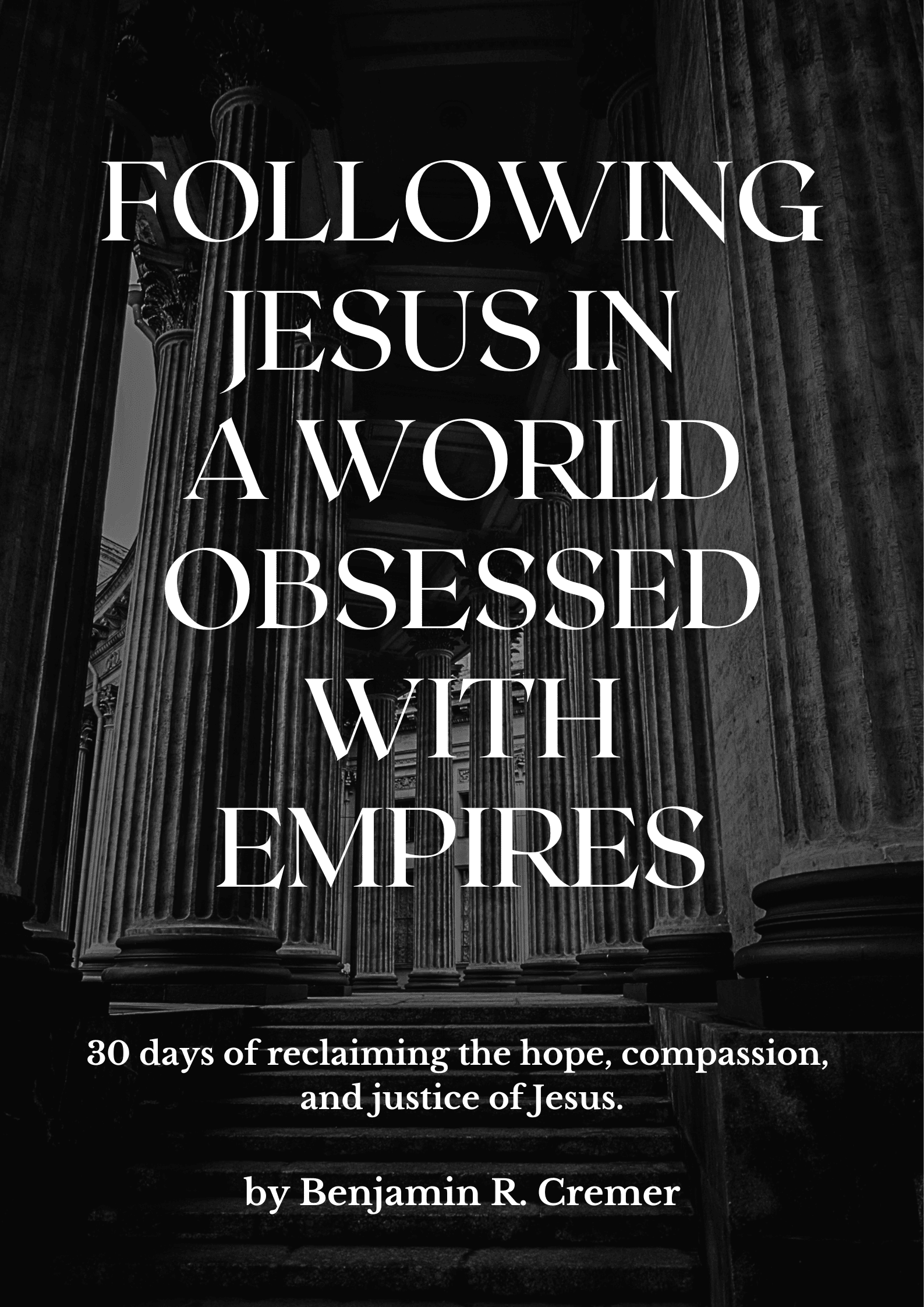
A 30 Day Day Devotional:
I wrote a daily devotional in hopes to provide a companion for people seeking to follow Jesus through the season of we are currently navigating together. You can find out more below:
 |
$20.00
Following Jesus In A World Obsessed With Empires: 30 Days of reclaiming the hope, compassion, and justice of Jesus.
Today, our world can often feel overwhelmed by darkness, division, and despair. I created this 30-day devotional to... Read more |
Ways to support:
If you'd like to support this project, you can do so through one-time-gift of any amount you feel is right. You can also subscribe through a $5/mo, $15/mo, or $25/mo. Several others have also asked for a recurring gift option that is different from the ones offered here, like this one. If you'd like me to set up a different option for you, please just send me an email with the word "support" in the subject line.
As always, I really want to thank all of you for reading and for all the ways you support me and this project every single week. I'm thankful for the ways we are building this together and hope it creates a lasting, positive change in our world along the way!
I sincerely appreciate you all,
Ben
Remember, you can now view this and all previous newsletters as well as invite friends to join through this link: https://benjamin-cremer.ck.page/profile.
|
|