|
Hello my friends,
I know it is not the norm for me to send out a newsletter midweek like this, so I hope you don't mind.
Given the recent news about more than a hundred service members filing complaints that a commander told them that war with Iran is part of “God’s divine plan,” that a sitting president is “anointed by Jesus” to ignite Armageddon, it is important to make it clear how unbiblical this claim is. This claim has more to do with the fiction series of “Left Behind” and dispensational theology than it does the Book of Revelation. So, I wanted to look at the context of the Armageddon in the Book of Revelation with you today. Also, this is why the separation of church and state is crucial!
Recommended Resources
-Reading Revelation Responsibly by Joseph Gorman. This is by far my favorite commentary on the Book of Revelation. If you haven't read it yet, I highly recommend doing so.
-Revelation for the Rest of Us: A Prophetic Call to Follow Jesus as a Dissident Disciple by Cody Matchett and Scot McKnight. This one comes highly recommended to me by some very trusted biblical scholar friends of mine. I am planning to read it soon, so I thought I would recommend it here if you'd like to read it as well.
-Untangling The Rapture I wrote this article over two years now on the kind of theology behind the modern concept of the rapture. Given recent events, I thought it was relevant to today's topic.
There is no “battle of Armageddon” in the book of Revelation.
The Book of Book of Revelation was composed in the late first century, most likely during the reign of Domitian, when the Roman Empire demanded not only political loyalty but religious reverence. Rome ruled through claiming divine sanction. Emperors were hailed as “Lord” and “Savior” and participation in imperial cults was a sign of allegiance. Refusal could mean marginalization, economic exclusion, or worse.
It is that context where John of Patmos writes his vision.
Revelation is not a coded forecast of 21st-century geopolitics. As John writes in verse one, the entire letter is the revelation of Jesus Christ. It is the way of God through Jesus Christ being revealed in the world. It is written in the prophetic genre of apocalyptic resistance literature. It pulls back the curtain on earthly empires and names them for what they are: beastly.
Rome is depicted as the first Beast, seven heads representing the seven hills of Rome. The second beast is the propaganda machine for the first beast, looking like a lamb but speaking for the dragon. Then the mark of loyalty to the beast is a number (666 or 616 in some manuscripts), and when using gematria, the number is transliterated into Hebrew (nrwn qsr) it points to Emporor Nero, one of the worst persecutors of the early church (Rev. 13).
John also describes Rome’s economic system becomes “Babylon,” drunk on luxury and the blood of the saints. (Rev. 17 & 18).
John is offering a theological critique of imperialism in contrast to the way of the crucified Lamb (Jesus Christ). He is telling persecuted Christians that while the empire looks invincible is not ultimate. Its violence is not divine. Its claims to eternal rule are a parody. They will not have the last word.
This is the contrast to keep in mind when we consider the famous “battle of Armageddon,” which appears in Revelation 16:16. The kings of the earth gather at a place called Armageddon, from “Har-Megiddo,” Mount Megiddo, which is a symbolic site associated with decisive Old Testament conflicts.
But here’s the striking detail many miss: no battle is actually described.
The nations gather. The stage is set. But when we reach Revelation 19, where we expect a final and epic clash of armies, something else astonishing happens.
Christ appears as a rider on a white horse. His robe is dripping with his own blood, not his enemies. Legions of angel armies are flanked behind him, armed to the teeth. Then they just stand there. The word comes out of his mouth, which is described as sharper than any double edged sword (the advanced weapon of the time). And the Beast and the kings of the earth are defeated, not through violent warfare, not, but by the word that proceeds from him, but the word that is revealed through him, buy the Word that is him (John 1).
There is no prolonged fight. No exchange of blows. No suspenseful military drama. No Christian foot soldiers taking up arms against hostile evil forces as the “Left Behind” series would have us believe. The “battle” is over before it begins. We are then given a casualty report of the enemy’s of God in Rev 19:20-21.
It is a powerful depiction of how Jesus has defeated sin and death through his self giving love on the cross.
Even earlier, in Revelation 5, John hears of the Lion of Judah. But when he turns, he sees a Lamb, standing as though slain.
This is the entire theological center of the book!
Victory in Revelation does not come through superior violence. It comes through faithful witness, sacrificial love, and divine judgment enacted by truth itself. The conquering Messiah conquers as the slain Lamb, not as a beast.
It is a fragile, insecure god that needs weapons and armies to achieve victory. It is an all powerful God that creates and dismantles simply by speaking a word. The Word.
Empire thrives on spectacle, like parades, armies, intimidation, and crucifixions lining the roads. Revelation subverts that spectacle. It stages what looks like the ultimate imperial showdown and then refuses to narrate it as a conventional war.
Why? Because the point is not that God wins by out killing Rome. The point is that Rome’s power is the hollow and endless cycle of violence. God’s power is the redeeming, nonviolent power of self sacrificial love (the cross).
In the ancient world, empires justified war as divinely sanctioned. Rome claimed Pax Romana, which means the “peace of Rome,” and it was secured by conquest. Peace through domination.
Revelation exposes that as counterfeit peace. “Babylon” falls not because Christians take up arms, but because her violence results in a self inflicted wound as all empires inevitably do, leading to her collapses under divine judgment. The merchants weep when she falls, not because of lost lives, but because of lost profits. It is a piercing indictment of economic exploitation fused with military power. Same story repeats throughout history and today.
The so-called final battle reveals that God does not need legions to defeat tyranny. Empire gathers for war. God simply speaks.
So this is the crucial theological meaning of the book of Revelation:
-God’s victory is not symmetrical with empire’s violence. God does not mirror the beast to defeat the beast.
-Faithful witness, not armed revolt, is the church’s calling. The saints “conquer” by the blood of the Lamb and the word of their testimony (Rev. 12:11), not by seizing power.
-Imperial claims are temporary. What looks absolute is already judged in heaven’s perspective.
-Evil always self-destructs when confronted by truth. The absence of a literal battle underscores that evil has no ultimate substance before God’s reign.
All this to say, when Revelation is read as a blueprint for inevitable global warfare, it can be co-opted to sanctify violence or to arrogantly believe that Jesus’ return can be manipulated into happening by causing “Armageddon” as we are seeing again today. In its original context, it functioned as a pastoral encouragement to marginalized believers: Do not fear the empire. Do not worship it. Do not become like it.
Armageddon is not a call to arms. It is a dramatic unveiling of the futility of arms before God.
The final word of Revelation is not war but renewal. It is a new heaven, a new earth, and a city where the nations bring their glory, not their weapons, into the light of God.
The empire gathers for battle.
The Lamb reigns without fighting.
The battle was already won on the cross.
That contrast is the critique.
We want the warhorse.
Jesus rides a donkey.
We want the eagle.
The Holy Spirit descends as a dove.
We want to take up swords.
Jesus takes up a cross.
We want the roaring lion.
God comes as a slaughtered lamb.
We keep trying to arm God.
God keeps trying to disarm us.
|
Now I'd like to hear from you!
Did you find this helpful? What thoughts came to your mind as you read? Feel free to respond to this email and share your thoughts with me. I look forward to reading them.
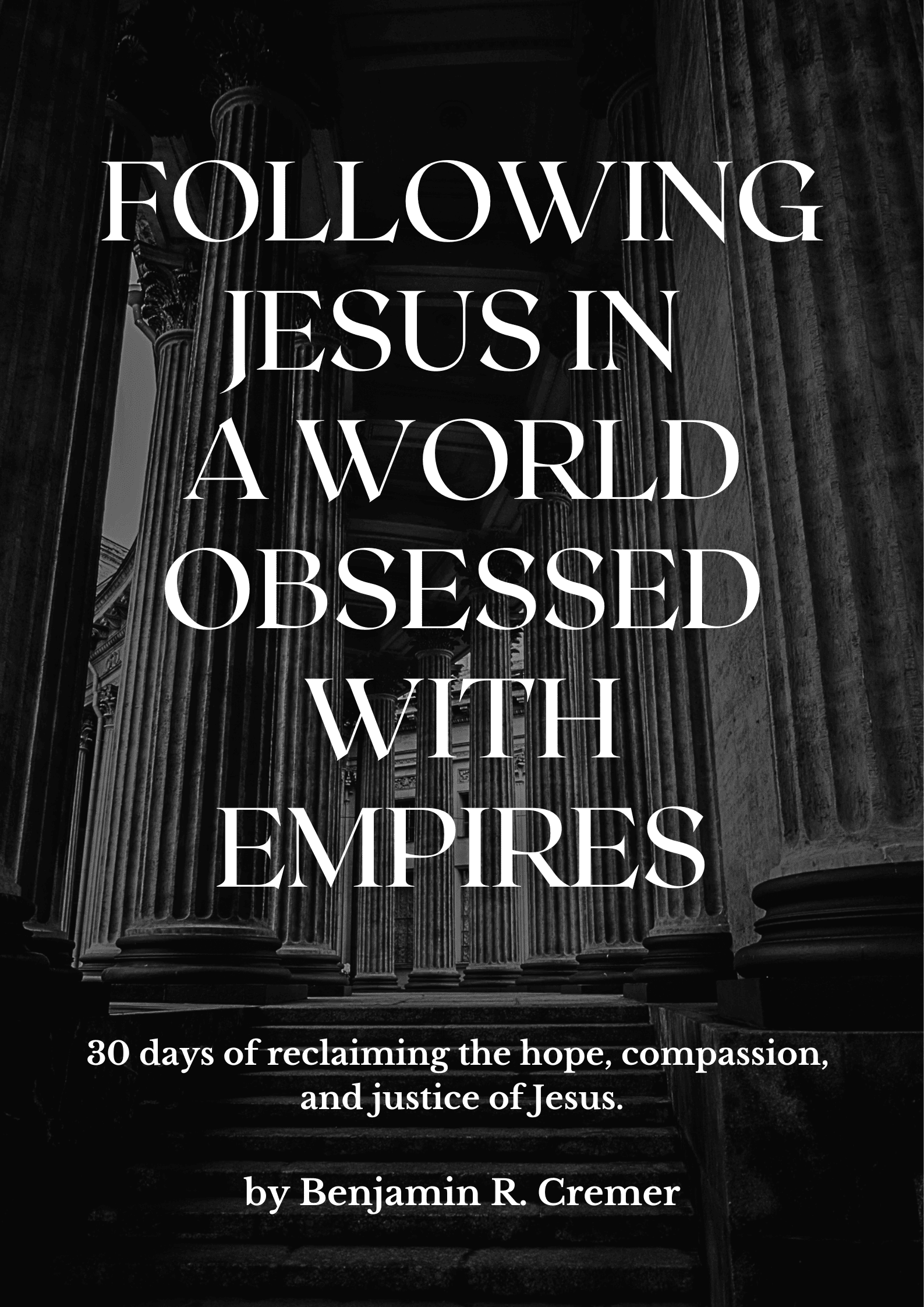
A 30 Day Day Devotional:
I wrote a daily devotional in hopes to provide a companion for people seeking to follow Jesus through the season of we are currently navigating together. You can find out more below:
 |
$20.00
Following Jesus In A World Obsessed With Empires: 30 Days of reclaiming the hope, compassion, and justice of Jesus.
Today, our world can often feel overwhelmed by darkness, division, and despair. I created this 30-day devotional to... Read more |
Ways to support:
If you'd like to support this project, you can do so through one-time-gift of any amount you feel is right. You can also subscribe through a $5/mo, $15/mo, or $25/mo. Several others have also asked for a recurring gift option that is different from the ones offered here, like this one. If you'd like me to set up a different option for you, please just send me an email with the word "support" in the subject line.
As always, I really want to thank all of you for reading and for all the ways you support me and this project every single week. I'm thankful for the ways we are building this together and hope it creates a lasting, positive change in our world along the way!
I sincerely appreciate you all,
Ben
Remember, you can now view this and all previous newsletters as well as invite friends to join through this link: https://benjamin-cremer.ck.page/profile.
|
|